

Jean Chartron
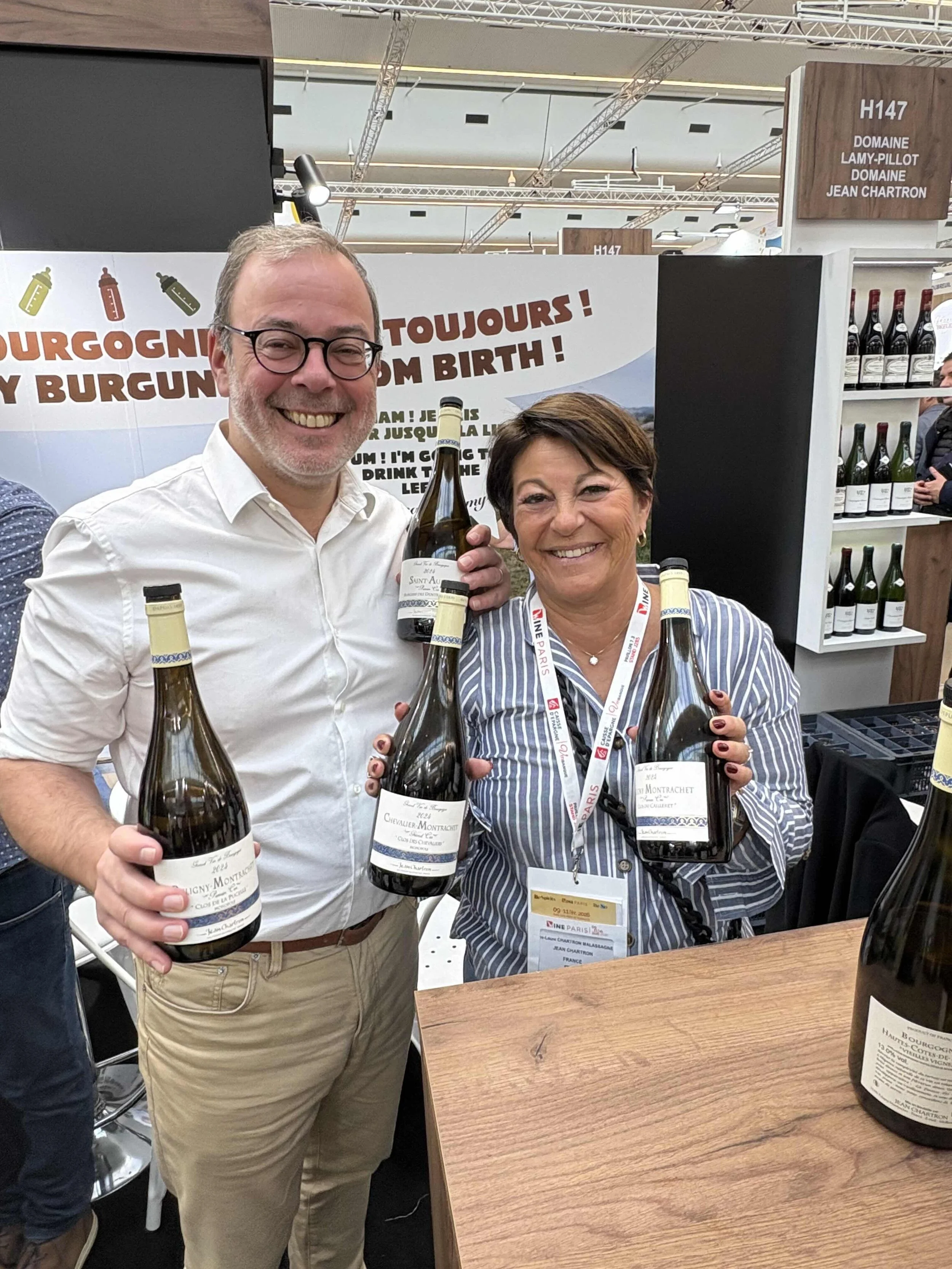
Domaine Jean Chartron, capably managed by the energetic Jean-Michel Chartron since 1994, is now unequivocally one of Puligny-Montrachet’s top producers. With an enviable collection of Puligny’s finest premiers crus and a winemaking approach that does full justice to these great white wine terroirs, Jean-Michel is now making some of white Burgundy’s most exciting wines.
The origins of the estate go back as far as the mid-19th century when Jean-Edouard Dupard founded the estate. While mayor of the village of Puligny in the 1870s, it was he who passed a resolution to append the name of the village’s most famous vineyard, Le Montrachet, to create today’s Puligny-Montrachet. His daughter married a Chartron and brought the family vineyards under the Chartron name.
Today the Chartron family owns 14.5 hectares (36 acres) of vines, throughout the Côte de Beaune, and also in Rully, in the Côte Chalonnaise, 20 minutes south of Puligny-Montrachet.
Right: Jean-Michel Chartron and sister Anne-Laure at Wine Paris, 2026
Wines, vineyards and winemaking
Bourgogne Chardonnay VV Tech sheet | Label | Bottle shot
Rully Montmorin Tech sheet | Label | Bottle shot
Jean-Michel’s vineyards are scattered across the Côte de Beaune, and include white production from Savigny-Lès-Beaune, Santenay, St. Aubin and the Hautes-Côtes de Beaune. The family has a substantial (3.5ha) holding of village lieu-dit Rully Montmorin, in the Côte Chalonnaise, a source of classic white Burgundy for a fair price. Among the more celebrated names, the family owns a full half a hectare of Chevalier-Montrachet grand cru, and small amounts of Bâtard-Montrachet and Corton-Charlemagne. The holdings in Chassagne-Montrachet are small, but include an outstanding small piece of Caillerets premier cru.
In the home village, the family is blessed with a trinity of the finest Puligny premiers crus: Clos du Cailleret and Pucelle (a full hectare of each) and half a hectare of Folatières. However, what volumes they own in premier cru, they lack at village level, so swap with neighboring producers in order to offer additional village level Puligny-Montrachet. As Jean-Michel notes with a grin, for each premier cru, there is an ‘exchange rate’ of so many barrels of village wine for one barrel of premier cru.
The vineyards are worked organically (not certified), and Jean-Michel is known as being among the very earliest pickers in the village. This decision is important in determining the style of the wines: one that favors energy, precision and minerality rather than soft or overly rich fruit. All the whites are subject to traditional barrel fermentation and aging, before being returned to stainless steel for a period of several months prior to bottling. This last technique is designed to return the wines to a reductive state after barrel aging, ensuring the wines show great freshness and energy (and just a hint of reduction) when opened. This is classic Puligny-Montrachet, in all its nervy, mineral glory.